Neither Jim Avery nor Kevin Keane ever attended OLS as students themselves. Yet they share the distinction of being the longest-running coaching team in the school’s basketball history. In this interview, hear them talk about the game they loved, the winning and losing, the life lessons they taught their players — and that signature OLS spirit that made it all possible.
The Lance: Neither of you attended OLS. So how did you both end up becoming the heart and soul of its basketball program?
 Jim Avery: My first two years coaching were at Stepinac. Then I stopped for a while. When I met my wife, Mary Lou (Hill) — her parish was OLS, and she was very close to Sister Cecile. One day Sister Cecile mentioned to Mary Lou that she was looking for a coach, and Mary Lou volunteered me on the spot. We weren’t even married yet, I was only 23 at the time! I thought I’d sign up for one year. That turned into eight before Kevin even came aboard. As it turned out, OLS became our parish, all our kids went there. It was just perfect.
Kevin Keane: One day Jimmy said to me, “Come and get involved with basketball.” I always loved the game, so I thought it might be fun to coach. My daughter Michaela was probably three or four years old when I started. We ended up coaching together almost 22 years.
The Lance: Twenty-two years is a long time to work alongside anyone. What made your partnership so successful?
Kevin Keane: We just had a special chemistry. I don’t think we ever argued once — not even the slightest difference of opinion in 22 years. And it wasn’t just about basketball. Our kids were friends, our families got together constantly. The program was a big part of both our kids’ growing up.
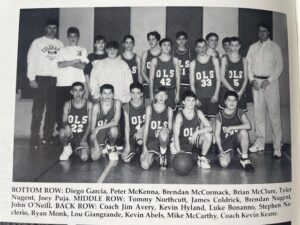
Jim Avery: Whenever you coach with someone, you get little differences of opinion. But with Kevin, 22 years, it was like we had ESP. If I was thinking about a substitution, he’d already made it. Once we started coaching together and our kids started coming to practices, it became way more than coaching. It became our life — our family. We’d go to games, then grab pizza afterwards. It was our social life, and it was awesome.
The Lance: Did you divide responsibilities — good cop, bad cop, offense and defense? Or was it fifty-fifty?
Jim Avery: Pretty much fifty-fifty across the board. But we did have one arrangement that was really smart — actually Kevin came up with it. When my son was on the team, Kevin coached him. When his son was on the team, I coached him. So neither of us had to get on our own kid directly. We relied on each other for that.
Kevin Keane: You’d pull me aside and say, “He’s being lazy.” And I’d say, “Don’t worry, I see it too — I’ll say something to him.” It just worked.
The Lance: You consistently ran rosters of 20 kids or more. How did you keep everyone invested when playing time is limited?
Kevin Keane: In 20-plus years of coaching 20 kids at a time, I can count on one hand the number of complaints I got about playing time. Everybody got to play. We still won. We had a nice balance. And more importantly, the last kid on the team was happy just to be part of it. I think about Joey Puja — he came to me and said, “Coach, you don’t have to put me in, I’m just happy to be on the team.” That’s what it was all about. It was a community.
Jim Avery: The starters understood the deal. When we got a lead and the 13th through 20th kids got in, those good players would turn around and cheer for them. They knew — you come to practice, you work, you deserve to play. Not one of them made a face about it.
The Lance: You ran 7th and 8th graders together. What did mixing those age groups do for the program?
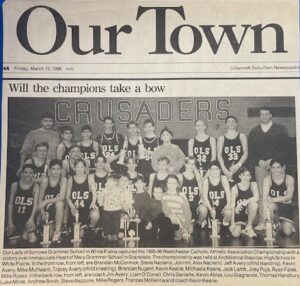
Kevin Keane: The 7th graders would watch the 8th graders and just want to be good next year. After the season ended, you’d see them up at Highlands playing together on their own, because they wanted to be ready. That’s what a program looks like — kids who want to come back, who want to improve, who want to be part of something.
Jim Avery: The fundamentals we taught carried over. I remember one team — Eddie Fargo, Chris Davis, that group — they weren’t stars, but they were fundamentally sound. Seven kids from that team went on to make their high school teams the following year. Not necessarily starters, but the coaches kept them because they were coachable. That’s how Kevin and I measured ourselves.
The Lance: Beyond basketball, what values were you most deliberate about instilling?
Kevin Keane: One thing I’d be remiss not to mention — Coach Avery was adamant about this — when we came in second, we stayed. We shook the other team’s hand. We stood there when they got their first-place awards and we clapped for them. Just respectful adults. That was one of those life lessons we were always determined to teach. To this day, kids who played for us will say they learned more from us than just basketball.
Jim Avery: It was the foremost thing on our minds. We wanted to win games, absolutely. But we wanted to walk into any gym and have people say, “There are the OLS kids — well-behaved, they play hard, they have real character.” They’d go up to the other coach and say hello. And the thing is, we had great families behind us sending us great kids. It was easy to teach them these things, and so rewarding to watch them carry it.
The Lance: Over 22 years you coached a lot of talented kids. Any players or teams that stand out?
Kevin Keane: After a while they all blend together — and I mean that in the best way. My first team was Kyle Walsh, Darren Austin, that group. Kyle went on to play at Fairfield, Kevin O’Keeffe went to Manhattan. Griffin Nugent’s team was something special — I remember a game down at St. John’s with Chris Gazzola and Griffin, just an unbelievable game. And a Barnabas tournament game with that same group where we won something like 82-80. Kevin and I just sat there watching them play like high school kids.
Jim Avery: Peter McKenna, Michael McCarthy — that was a very good team. We lost in the championship down at Fordham to Transfiguration that year. Their kid came out in a triangle-and-two on us. Our kids were wide open and just couldn’t hit a shot. Kevin Highland was a terrific player — he went on to play at Holy Cross. And then there was the team with Robbie O’Toole and Bronzo. We couldn’t get them to practice because they were on six different teams — they were that sought after.
The Lance: Who was the most physically dominant player you coached in all those years?
Jim Avery: Francis McKenna. Probably the most dominant eighth grader we ever had — and we had kids who went on to play Division I. But Francis was so strong. He’d start his dribble toward the basket and the sea would just part. Everybody got out of his way and he’d score. It was man against boys.
Kevin Keane: We used to have to bring his birth certificate to games. Nobody believed he was in eighth grade. He was built like a man-child at that age. Francis was a great athlete.
The Lance: What was it about this community that kept you coming back year after year?
Kevin Keane: It was like a little family on the team. That’s why a kid would be happy just to be on the team — because he wanted to be part of the family. He didn’t need to play 20 minutes a game. He wanted to be with his friends, learn something, belong to something. And honestly, that made it fun for us too. We always had great parent support. Between the two of us, we were good communicators, and I think the parents trusted us. Everybody felt included. That was the whole thing.
Jim Avery: The young men we coached, one after another — some teams really good, some middle of the road — but the kids were just great kids from great families. There was always a connection. Our kids connected with each other, with us, with each other’s families. Some teams from other schools would come in, play their game, and just leave. No connection. With OLS, there was always something more.