From the OLS hallways to hospice care, Sr. Patricia reflects on a life of service, community, and compassion.
The Lance: You first came to OLS as a fourth-grade teacher. When was that?
Sr. Patricia: I came to OLS in 1970. Sister Cecile and I arrived at the same time. She taught first grade, and I taught fourth grade. I loved it. I loved being there.
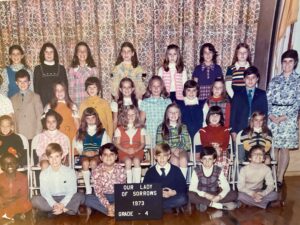
From my first class, I remember Michael Jordan, especially because of his parents—they were so involved and Mr. Jordan was so clever and funny. We used to have the school picnic at the beginning of the year, and before they met me, Mr. Jordan teased Michael about his new teacher, calling me “Mean Nadine” — at that time, my religious name was Nadine. Later on, we were given the option to go back to our given names, and I chose to do that.
The Lance: And that couldn’t be more opposite of how everyone thinks of you! So you were a fourth-grade teacher for six years, and then you became principal. What was that transition like?
Sr. Patricia: I was asked by the congregation to take the role. For some reason, I just said yes. I don’t think I really thought about it, but looking back, I think I just felt ready for a change. I was organized, and that was the main thing I felt I could offer—organizational skills. I loved it. We had a wonderful faculty. They were supportive of me, and I have very fond memories of working with them. And friendships have endured for years among former OLS teachers.
The Lance: What are some of your favorite memories of OLS?
Sr. Patricia: Besides Mr. Jordan and his cleverness, Mr. O’Toole is also a big memory. He was always around, gathering kids, helping them, teaching them—especially through basketball. He gave students a sense of feeling good about themselves, which is one of the most important things a teacher or parent can give a child.
Another fond memory I have was the adult talent show. One year all the mothers did the can-can, including Mrs. Sullivan. The fathers did acts too—the Blarney Boys with Mr. Schulz and Mr. Dee. It was so much fun.
The parental support and the community spirit at OLS really stand out. Parents were always involved—coming to performances, games, being present. That meant so much to the children. It helped build their sense of self-worth. We had many big families, and that created such a strong sense of connection. There was a tremendous sense of belonging, and it continued long after. When you think about it, the friendships are still so strong—siblings, families, everyone stayed connected.
The Lance: It really is remarkable! Now, although many of us think of you as a fixture in the OLS community, we don’t actually know where you came from! Can you share a bit about your early life?
Sr. Patricia: I was born in White Plains at St. Agnes Hospital, but I grew up in Chappaqua. My parents were from Ireland. There wasn’t a Catholic school in Chappaqua at the time, so I attended St. Thomas School in Pleasantville, then Good Counsel High School.
I had one brother, who was a year and a half older than me. He worked in real estate with my father for a time, then earned his social work degree and worked primarily with older adults.
My mother worked with my father in his grocery business doing the accounting. Later, she took a part-time job and loved having work of her own. She was also very artistic—she painted and played the violin and piano.
The Lance: You left OLS in 1985 and have held several different jobs in the area. Tell us more about “life after OLS.”
Sr. Patricia: After I left OLS, I entered a program at Calvary Hospital that was designed for religious who were considering a career change. For a year, I rotated through many hospital departments—nursing, housekeeping, laundry, admissions, and social work.
Social work really sparked something for me. After the program, I was hired at Calvary’s Palliative Care Institute, which focused on cancer care. I coordinated outreach programs for a couple of years and then began working toward my social work degree while I continued to work there.
After that I completed two internships—first at St. Agatha’s Home, a residential foster care setting for children with special needs, and then at the Peekskill Mental Health Clinic. After earning my degree, I was hired in 1992 at White Plains Hospital’s Mental Health Clinic. I worked there for about eight years with a wonderful team.
Then I moved into leadership within my congregation for eight years. After that, I became director of the RDC Center for Counseling and Human Development, where I also saw clients. I was there for 14 years and retired in October 2022.
After retiring, I became certified as a bereavement counselor, and in 2024 I was hired as a hospice social worker with Hospice of Westchester.
The Lance: Many people don’t really know what happens when someone goes into hospice. Can you explain more about it for us?
Sr. Patricia: When someone comes onto hospice, there’s a full team—a nurse, social worker, chaplain if they wish, volunteers if they wish, and a medical director overseeing care.
I go as a social worker, not in my role as a religious sister. I provide emotional and psychological support to both patients and families. That includes helping them process fears, grief, and the reality of dying, as well as offering practical guidance when needed.
Sometimes patients are too sick to communicate, so much of the work is with families—helping them accept what’s happening and supporting them through it.
It’s really a privilege to be with people at the end of their lives. When I meet them, I’m seeing them at their most vulnerable, but they’ve lived full, beautiful lives before I ever arrive. Often I learn about those lives through their families.
The Lance: Many people think working in hospice care must be so hard.
Sr. Patricia: I don’t find it hard in the way people expect. Hospice patients must meet the criteria of having an estimated life expectancy of six months or less. That’s why hospice has a stigma, because it means facing death, and people often come onto the program very late, missing out on the full support hospice can offer. It’s really about supporting people physically, emotionally, and psychologically. The nurses are incredible advocates for comfort and dignity.
The Lance: When you look at your career—from teaching children, to helping adults with mental health struggles, and now to hospice—it’s all about service.
 Sr. Patricia: Yes, it really is. Looking back, it was when I got to Good Counsel that I really connected to service and religious life. I loved the spirit of the sisters there, the Sisters of Divine Compassion, and what they represented. I wanted to be like them.
The Lance: On behalf of the OLS students who had you as a teacher in 4th grade and as principal, we’re grateful to the Sisters for giving you that calling! Final question: Do you still run?
Sr. Patricia: When I was principal, two of my teachers gave me a pair of running shoes as a gift. That is how I started running! I did it ever since, but as I got older I started walking instead. I now walk 4 ½ miles each morning, in and out of the neighborhoods near where I live. I do it to keep healthy. Right now, it feels good when I finish and it is really just part of my life! So far, so good.
 A post-interview note from Sr. Patricia:
“I want to thank all the parents, students and teachers who together helped to create a wonderful spirit of community and learning during my tenure at OLS. Because of their support and participation, in so many myriad ways, the school flourished, laid the foundation for friendships that have endured throughout these many years, and cultivated women and men who are caring and giving. Each of our students are helping to make our world a better place and I congratulate you on all your achievements. Special thanks to Sr. Cecile, who was a great support to me and who has led the school for so many years and made it into the wonderful place of learning that it is today.”